
Tips
The Ultimate 316 Stainless Cutting Guide: Speeds, Feeds, Blade Picks & Work-Hardening Fixes (Fits on Two Pages)
By Cut316 Shop Team · 5/21/2026 · 14 min read
The Ultimate 316 Stainless Cutting Guide: Speeds, Feeds, Blade Picks & Work-Hardening Fixes (Fits on Two Pages)
Look, I've been running a shop that does nothing but 316 stainless for over 25 years. I've watched guys walk in with the right machine and completely wrong parameters, trash a $400 end mill in four seconds, and then blame the material. The material isn't the problem. The setup is.
This guide is what I wish I'd had on day one. Everything in one place. Laminate it. Pin it above the Haas. Argue with it at 2 AM when a job's going sideways. It's built to be used, not read once and forgotten.
Why 316 Machines the Way It Does
Before we get to numbers, you need to understand why 316 behaves the way it does — because every parameter in this guide traces back to the same root cause.
316 is an austenitic stainless. It contains roughly 16–18% chromium, 10–14% nickel, and 2–3% molybdenum. That molybdenum is what separates it from 304 — it significantly improves pitting and crevice corrosion resistance, which is why 316 dominates marine, chemical processing, and medical applications. See our full 316 vs 304 Stainless Guide for the deep comparison.
Here's what those alloy additions mean at the cutting edge:
- High work-hardening rate. 316 work-hardens faster than most common engineering alloys. Stop a tool mid-cut, hesitate, dwell — and you've just created a surface layer that's harder than what you started with. The next pass fights a different material.
- Low thermal conductivity. Heat doesn't travel through 316 the way it does through carbon steel. It concentrates right at the tool tip. That's how you burn a coating off an end mill in one pass with no coolant.
- Gummy, stringy chips. The ductility that makes 316 tough in service makes it want to stick to cutting edges and build up. Built-up edge (BUE) is a constant enemy.
- 316L specifics: Low-carbon variant (C ≤ 0.03% vs. ≤ 0.08% for standard 316). Machines nearly identically — maybe 5% more gummy since reduced carbide precipitation makes the chip even more ductile. Use the same parameters; back off surface footage by about 5% if you're seeing more BUE than usual.
Section 1: Bandsaw Parameters for 316 Stainless
The biggest mistake I see: running too fast. Guys come over from carbon steel and keep the blade speed up. 316 will eat that blade alive in under a minute.
Blade Selection Table
| Material Form | Blade Type | TPI | Set Style |
|---|---|---|---|
| Solid bar up to 2" | Bi-metal M42 cobalt | 10–14 | Wavy |
| Solid bar 2"–6" | Bi-metal M42 or carbide-tipped | 6–10 | Raker |
| Tubing / thin wall | Bi-metal M42 | 14–18 | Wavy |
| Heavy section 6"+ | Carbide-tipped | 3–6 | Raker |
| Sheet / plate | Bi-metal M42 | 14–18 | Wavy |
My go-to: M42 bi-metal in the 8–10 TPI range handles about 80% of what comes through my shop. Carbide-tipped blades cost more up front but earn it back on high-volume production runs.
[Recommended M42 Bi-Metal Bandsaw Blade – Amazon Affiliate Link]
Bandsaw Speed and Feed
| Bar Diameter | Blade Speed (SFPM) | Feed Pressure |
|---|---|---|
| Up to 1" | 90–130 | Light, consistent |
| 1"–3" | 70–100 | Medium, steady |
| 3"–6" | 50–80 | Medium-heavy |
| 6"+ | 40–60 | Heavy, use blade guide support |
Coolant: Sulfurized cutting oil or water-soluble coolant at 8–10% concentration. Never dry-cut 316 on a bandsaw. I don't care how fast you think you are — you'll be buying a new blade in twenty minutes.
Break-in procedure: New blades need the first 50–100 square inches of material cut at 50% of normal feed rate. Skip this and micro-chipping on the set teeth starts immediately. I've had apprentices skip break-in and wonder why the blade failed on the third cut.
Section 2: CNC Milling Parameters for 316 Stainless
This is where most machinists either win or lose the whole job. 316 rewards aggression when it's controlled aggression — light, fast, and never stopped.
End Mill Selection
Use carbide end mills — 4-flute minimum for general milling, 5–7 flute for finishing. AlTiN (aluminum titanium nitride) or AlCrN (aluminum chromium nitride) coatings are my standard recommendation. TiAlN works but AlCrN handles the heat better on 316 due to the coating's higher oxidation resistance.
See our full Best Carbide Tools for 316 SS Guide for brand-specific recommendations and test results.
CNC Milling Speeds and Feeds (Carbide, Coated)
| End Mill Diameter | SFM | RPM (approx.) | Feed per Tooth (in) | Axial DOC | Radial DOC |
|---|---|---|---|---|---|
| 1/8" | 200–250 | 6,100–7,600 | 0.0008–0.0012 | 0.5×D | 0.25×D |
| 1/4" | 200–250 | 3,100–3,800 | 0.0015–0.002 | 0.5×D | 0.25×D |
| 1/2" | 200–250 | 1,500–1,900 | 0.002–0.003 | 0.5×D | 0.3×D |
| 3/4" | 200–250 | 1,000–1,270 | 0.003–0.004 | 0.5×D | 0.3×D |
| 1" | 180–220 | 690–840 | 0.003–0.005 | 0.4×D | 0.25×D |
Critical rules:
- Never let the tool dwell. Keep the feed moving. A tool spinning without cutting is work-hardening the surface for the next pass.
- Climb milling preferred when setup rigidity allows. Reduces BUE and improves surface finish.
- Keep chip load up. Thin, rubbing chips generate heat. Thick chips carry heat away. Counterintuitive but real.
- Flood coolant always. If you're doing any kind of production 316 milling without flood coolant, you're burning money. Minimum 150 PSI coolant pressure at the tip. Through-spindle coolant if your machine supports it.
Section 3: CNC Turning / Lathe Parameters for 316 Stainless
Carbide inserts are standard. For roughing, a sharp positive-geometry insert in a grade like Kyocera PR1535 or Mitsubishi MC6025 handles 316 well. Those aren't the only options — the key is sharp edge, positive rake, and a chipbreaker geometry designed for stainless, not just a general-purpose insert.
Turning Speeds and Feeds
| Operation | SFM | Feed (IPR) | Depth of Cut |
|---|---|---|---|
| Roughing | 200–300 | 0.010–0.016 | 0.080–0.150" |
| Semi-finishing | 280–380 | 0.006–0.010 | 0.030–0.060" |
| Finishing | 350–500 | 0.004–0.007 | 0.010–0.025" |
| Threading | 150–200 | Per pitch | — |
| Parting / Grooving | 150–200 | 0.002–0.005 | — |
Insert geometry notes:
- Positive rake angle (+5° to +15°) reduces cutting forces and BUE tendency
- Sharp honed edge (T-land no larger than 0.002") — don't use heavy T-land inserts meant for cast iron
- Chipbreaker that handles the long, stringy chips 316 produces
- For finishing: wiper-geometry inserts improve Ra values significantly without slowing the machine
Coolant: High-pressure coolant (HPC) at the insert face changes the game on 316 turning. We went from 250 SFM to 380 SFM on finishing passes when we added HPC on our Mazak. The heat management alone is worth the investment.
Section 4: Drilling 316 Stainless
Drilling is where I see the most work-hardening disasters. Here's the failure sequence I've watched play out a hundred times: operator uses a dull drill, pushes slowly, chips pack in the flutes, heat builds, drill backs out to clear chips — and now the hole bottom is work-hardened. Next drill hits hardened material. Catastrophic failure. Broken drill. Scrapped part.
Drill Selection
- Cobalt (M42) jobber drills for general work. Sharp, positive geometry. Replace at first sign of dulling.
- Carbide drills for production runs, holes deeper than 3×D, or tight-tolerance work.
- Split-point geometry (135° included angle) reduces thrust force and walking. Non-negotiable on 316.
- TiAlN or AlCrN coating on carbide drills extends life dramatically in 316.
[Recommended Cobalt Drill Set for Stainless – Amazon Affiliate Link]
Drilling Speeds and Feeds
| Drill Diameter | SFM (HSS Cobalt) | SFM (Carbide) | Feed (IPR) |
|---|---|---|---|
| Up to 1/8" | 40–60 | 100–140 | 0.001–0.002 |
| 1/8"–1/4" | 40–60 | 100–140 | 0.002–0.004 |
| 1/4"–1/2" | 35–50 | 90–120 | 0.004–0.007 |
| 1/2"–1" | 30–45 | 80–110 | 0.006–0.010 |
| Over 1" | 25–35 | 70–90 | 0.008–0.012 |
Peck drilling: Use a peck cycle any hole deeper than 2×D. Full peck, not chip-breaking peck. Clear the flutes completely. On deep holes (5×D+), use through-coolant drills.
Never spot drill with a 90° spotting drill on 316. Use 120° or 142° to match your drill's included angle. Mismatched included angles create the exact rubbing-without-cutting situation that starts work hardening before you even enter the hole.
Section 5: Laser Cutting 316 Stainless
Fiber laser has become the dominant technology for sheet and plate work. CO2 still has a place for thicker sections where kerf quality matters most.
Fiber Laser Parameters (General Guidance)
| Thickness | Power (kW) | Speed (IPM) | Assist Gas | Pressure (PSI) |
|---|---|---|---|---|
| 16 ga (0.060") | 2–3 kW | 400–600 | Nitrogen | 150–200 |
| 11 ga (0.120") | 3–4 kW | 200–350 | Nitrogen | 150–200 |
| 1/4" | 4–6 kW | 80–140 | Nitrogen | 200–250 |
| 3/8" | 6–8 kW | 40–70 | Nitrogen | 200–250 |
| 1/2" | 8–12 kW | 20–40 | Nitrogen | 220–280 |
| 3/4" | 10–15 kW | 10–20 | Nitrogen | 250–300 |
Always use nitrogen assist on 316 stainless. Oxygen assist oxidizes the cut edge (brown/blue discoloration) and compromises corrosion resistance at the edge — defeating the whole reason you specified 316 in the first place. Nitrogen gives a bright, oxide-free edge that requires minimal post-processing.
316 vs. 304 on laser: 316 requires about 5–10% slower speeds than 304 at equivalent thickness due to slightly lower thermal conductivity. Not a huge difference, but worth noting when you're dialing in a new nest.
Section 6: Waterjet Cutting 316 Stainless
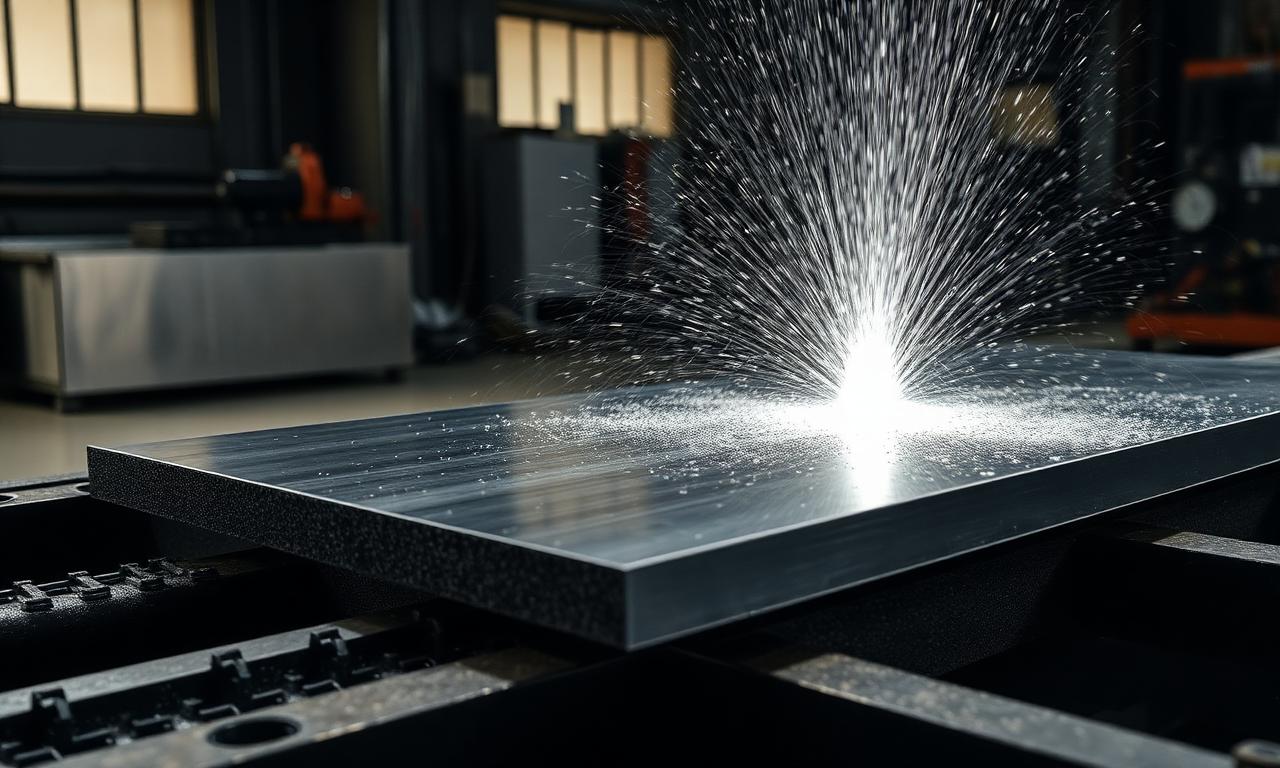
Waterjet is my preferred method for anything where heat-affected zones are completely unacceptable — medical device components, valve seats, anything with tight tolerances where laser-induced stress is a concern.
Waterjet Parameters
| Thickness | Pressure (PSI) | Abrasive (lb/hr) | Speed (IPM) — Quality 3 | Speed (IPM) — Quality 5 |
|---|---|---|---|---|
| 1/4" | 55,000–60,000 | 0.8–1.0 | 20–30 | 8–12 |
| 1/2" | 55,000–60,000 | 1.0–1.2 | 10–15 | 4–7 |
| 1" | 55,000–60,000 | 1.2–1.5 | 4–7 | 1.5–3 |
| 2" | 60,000–90,000 | 1.5–2.0 | 1.5–3 | 0.5–1.5 |
Quality 3 = production cut, slight taper, some striations. Quality 5 = near-mirror finish, minimal taper, weld/press-fit ready.
316 waterjet notes: No heat-affected zone. No work-hardening at the cut edge. No metallurgical changes. The garnet abrasive does leave some embedment on rough-cut surfaces — this can be addressed with a light pickling or passivation step if surface purity is critical.
Section 7: Work-Hardening — Prevention and Recovery
This deserves its own section because it's the most expensive problem in 316 shops and the most preventable.
Why It Happens
316 austenite transforms to martensite under cold working. Every time a dull tool rubs instead of cuts, every time feed rate drops too low, every time you dwell — you're strain-hardening the surface. The hardness increase can be dramatic: from roughly 200 HB in the annealed condition to 350+ HB after significant work hardening. That's harder than some tool steels.
Prevention Checklist
- ✅ Sharp tools, always. Replace on schedule, not on failure.
- ✅ Never stop feed mid-cut. If the machine alarms out, you may be scrapping the part.
- ✅ Minimum chip load above the rubbing threshold. Know your numbers.
- ✅ High feed rates preferred over high spindle speeds when in doubt.
- ✅ Flood coolant, always.
- ✅ Don't take interrupted passes that leave a thin skin of material.
- ✅ On multi-pass operations, never leave less than 0.005" for final finish passes to "clean up" — that stock needs to be removed properly.
Recovery: What To Do When You're Already In Trouble
If you've work-hardened a surface and still need to machine it:
- Increase SFM aggressively — go 20–30% higher than normal. You need the tool to cut, not rub.
- Increase depth of cut to get below the hardened layer. On a lathe, you may need to go 0.010–0.020" deeper than you planned.
- Ceramic inserts can handle the hardened layer where carbide struggles. Whisker-reinforced ceramic or SiAlON grades work here.
- CBN inserts for extreme cases where the surface has work-hardened to 40+ HRC equivalent.
- Annealing — if the geometry allows and the part isn't finished, solution anneal at 1900–2000°F (1038–1093°C) followed by rapid water quench. This dissolves the martensite back to austenite and restores original hardness. Not always practical but good to know.
Section 8: Coolant Selection for 316 Stainless
Not all coolant is equal on 316. Here's the hierarchy:
| Coolant Type | Application | Notes |
|---|---|---|
| Sulfurized/sulfochlorinated cutting oil | Tapping, drilling, reaming, slow ops | Best lubricity. Do NOT use on parts that will be welded without thorough cleaning — sulfur contamination causes porosity. |
| Semi-synthetic water-soluble, 8–12% | General CNC milling, turning | Best all-around for flood coolant systems. |
| Synthetic water-soluble, 6–10% | High-speed finishing, laser-adjacent ops | Good cooling, lower lubricity. |
| Neat cutting oil | Manual tapping, broaching | Maximum lubricity for slow, high-torque operations. |
| Nitrogen gas | Cryogenic machining | Emerging technology. Significant tool life gains on 316 reported in recent studies. High setup cost. |
Concentration matters: Too dilute and you lose lubricity. Too rich and you get bacteria, foaming, and a shop that smells like a gym locker room. Check Brix weekly. Maintain a log.
Chloride warning: Some older coolant formulations contain chlorides. Chlorides + 316 stainless = stress corrosion cracking risk in the finished part. Read your coolant SDS before you buy it.
Section 9: Plasma Cutting 316 Stainless
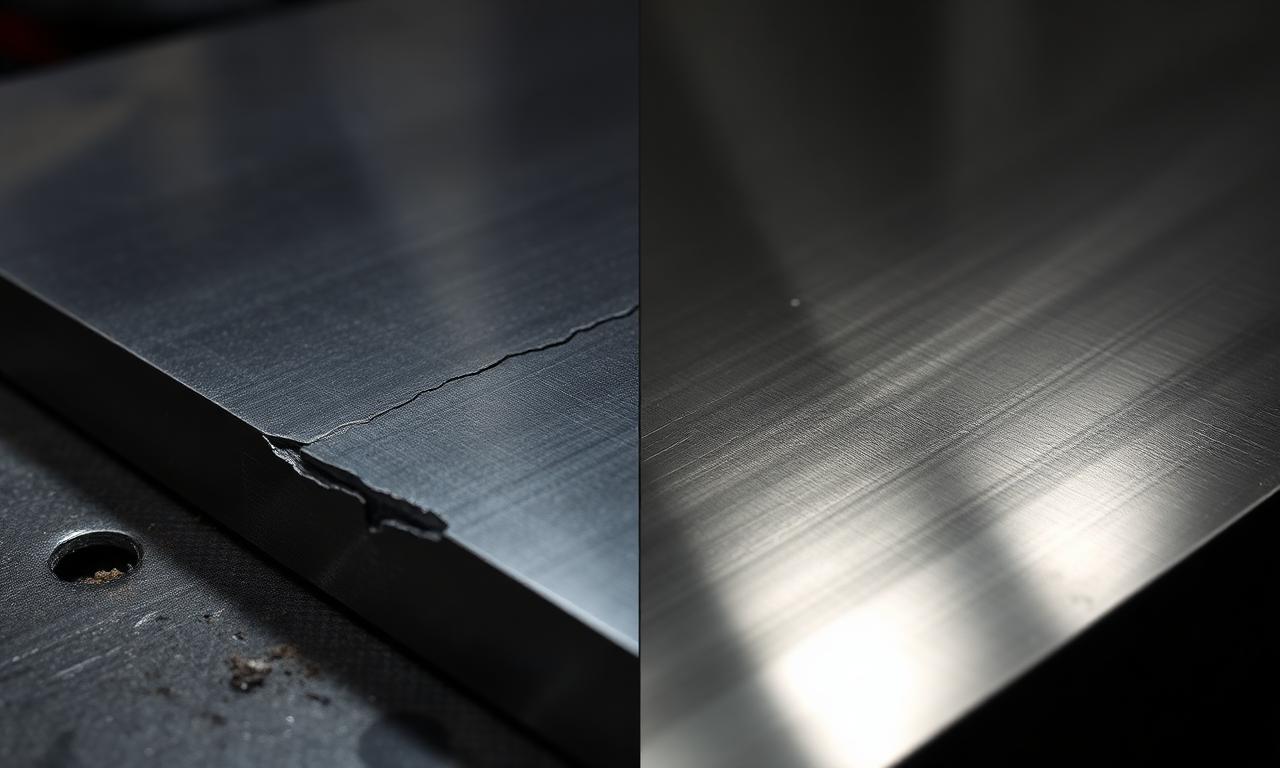
Plasma is fast and cheap but leaves a heat-affected zone and some metallurgical changes at the cut edge. Fine for structural work where you'll be machining away the edge anyway. Not appropriate for parts where edge corrosion resistance matters.
Plasma Parameters (Handheld and CNC)
| Thickness | Amperage | Speed (IPM) | Gas |
|---|---|---|---|
| 16 ga | 30–40A | 60–100 | Air or N₂ |
| 1/4" | 50–70A | 30–50 | Air or N₂/O₂ |
| 1/2" | 80–100A | 15–25 | N₂/O₂ or F5 |
| 3/4" | 100–130A | 8–15 | F5 or H35 |
| 1" | 130–200A | 5–10 | H35 |
Post-cut requirements: Any plasma-cut 316 that will be in a corrosive service environment needs the HAZ ground back a minimum of 1/16"–1/8" or the edge passivated/pickled. The chrome-depleted zone created by plasma heat is not 316 in terms of corrosion performance.
Section 10: Tapping 316 Stainless
Tapping is where I've lost more tools than any other operation. 316 galls. That's all there is to it — the material wants to cold-weld to anything that's rubbing against it under pressure.
Rules That Don't Change
- Spiral flute (gun) taps for through-holes. Chip evacuation upward, critical.
- Spiral point taps also work for through-holes on CNC.
- Hand taps only for very shallow blind holes with extreme patience.
- Cobalt or powder-metallurgy (PM) HSS taps minimum. Carbide taps for production.
- Tap drill sizing: Go to the high end of the recommended range. A 75% thread in 316 is as strong as the bolt. A 65% thread is fine for most applications. Don't fight for full thread depth — you'll break taps.
- Sulfurized tapping oil, applied liberally. Not coolant. Oil. Every time.
- Rigid tapping on CNC. Tension-compression holders for manual operations.
- Speed: 15–25 SFM for HSS/cobalt taps. 30–50 SFM for carbide.
[Recommended Spiral Flute Tap Set for Stainless – Amazon Affiliate Link]
Quick-Reference Summary Table
| Operation | Key Parameter | Rule of Thumb |
|---|---|---|
| Bandsaw | Blade speed | 50–130 SFPM depending on section size |
| CNC Milling | SFM (carbide coated) | 200–250 SFM, never let tool dwell |
| CNC Turning (rough) | SFM (carbide insert) | 200–300 SFM, 0.010–0.016" IPR |
| CNC Turning (finish) | SFM (carbide insert) | 350–500 SFM, 0.004–0.007" IPR |
| Drilling (cobalt) | SFM | 30–60 SFM, peck every 2×D |
| Tapping | Speed | 15–25 SFM, sulfurized oil |
| Fiber Laser (1/4") | Gas | Nitrogen always, 200+ PSI |
| Waterjet (1/2") | Pressure | 55,000–60,000 PSI, garnet |
| Coolant | Type | Semi-synthetic 8–12% for general use |
| Work hardening | Prevention | Sharp tools + keep moving + flood coolant |
What to Do When Things Go Wrong: Troubleshooting 316
"My end mill just snapped."
→ Check: was feed rate too low? Were you taking interrupted passes? Was coolant running? Did the tool dwell? Usually one of these four.
"The surface finish looks torn, not cut."
→ BUE. Increase SFM, use sharper insert, check coolant concentration, switch to a coating with better lubricity (AlCrN over TiN).
"My drill keeps walking even with center punch."
→ Use a 120–142° split-point drill. Use a stub-length drill for thin sheet. Use a spotting drill that matches the included angle.
"Bandsaw blade died after two cuts."
→ Too fast, no coolant, or skipped break-in. Also check for blade welds — a bad weld on a bi-metal blade fails immediately in 316.
"Parts are coming back with pitting at the cut edge."
→ Plasma or oxygen-assist laser cut. Switch to nitrogen on laser. Remove HAZ on plasma cuts. Verify passivation if required by spec.
The Bottom Line
316 is not a difficult material if you respect it. It rewards the machinist who uses sharp tools, keeps cutting, uses coolant like it's free, and understands that the work-hardening clock is always ticking. The parameters in this guide come from a couple decades of cutting this alloy every single day — they're not theoretical numbers off a chart, they're what actually works.
Bookmark this page. Or better yet, grab the PDF below and put it on the shop wall.
For deeper dives into each process, see:
- Best Carbide Tools for 316 SS — 2026 Buyer's Guide
- 316 vs 304 Stainless: A Machinist's Comparison
- Ultimate Guide to Cutting 316 Stainless Steel — All Methods
- Speeds & Feeds Calculator
📥 Free Download: The Complete 316 Stainless Cutting Reference PDF Everything in this guide — all parameters, tables, and troubleshooting — formatted as a clean, printable two-page shop reference. Enter your email and we'll send it straight to you.
[Email signup form — lead magnet CTA]
Affiliate · Tested in shop
Shop Our Top Tool Picks for 316 Stainless →
Bandsaw blades, carbide end mills, cobalt drills, tapping fluids and coolants that actually survive 316.
See recommended tools